Tag Archive for 'record labels'

Distribute Yourself All Over The Place

Are you a musician? Are you creating music that your friends and fans love? You want to distribute your jams but are completely confused in this weird music distribution world? We empathize… It’s hard to know where to go and what to do! You want to make sure that you will successfully and effectively distribute yourself all over the place, right? MixMatchMusic has been around the block a few times and has some good ideas of where you should go. While we were at this year’s Winter Music Conference, we made friends with a multifaceted service called Symphonic Distribution. Symphonic Distribution is a digital content distributor and services provider aimed at providing the best in content delivery, customer service, marketing, education, and more for music industry artists, managers, and record labels across the globe. They have a proven track record and currently provide services to hundreds of clients based in countries such as Brazil, Colombia, Argentina, Australia, Sweeden, Bosnia & Herzegovina, India, Japan, USA, Canada, Portugal, and countless other countries and cultures around the globe. In addition to their services, Symphonic Distribution also has several distinct brands for the intention of expanding the reach of a client.

SymDirect – www.symdirect.com
SymDirect is a upload fee based distribution service allowing artists and labels to keep 100% of their royalties. This service is different then the normal distribution model and in addition, undercuts MANY imitators. Consider this to be… the official post office of digital distribution. You pick the package (or shipping price), we deliver, and you get ALL of your royalties! No other charges or hidden fees!

SymIntranet – www.symintranet.com
SymIntranet is Symphonic Distribution and SymDirect’s portal for it’s signed labels and artists. The extensive portal includes marketing materials from stores, educational tutorials relating to music business, music production, and music marketing, and links to helpful initiatives aimed at helping labels grow! The website will continue to be updated to contain more educational materials, marketing plans, and more!

Check them out and please, don’t hesitate to shoot them an email if you’re interested in distributing your music and creating a name for yourself as an artist. support@symphonicdistribution.com

Share and Enjoy:
  • Twitter
  • StumbleUpon
  • Digg
  • Facebook
  • del.icio.us
  • MySpace
  • Technorati
  • FriendFeed
  • LinkedIn

A Music History Primer

The music “industry” has always been an extremely dynamic field that has paralleled the steady evolution of technology, business and society. The industry as we know it is more appropriately referred to as the record industry that began in the early 20th Century with the invention of the gramophone. But, the emergence of modern music is a relatively new development, as for the majority of its history, music was neither considered a form of entertainment nor a secular art.

Music (in some form or another) was an aspect of every ancient civilization, but was used in connection with religious rites/ceremonies. Similarly in medieval times, music was almost exclusively affiliated with social and religious rites and ceremonies. The secularization of music did not commence until the Renaissance, which began in the 14th Century and lasted until the middle of the 17th Century. Yet, until the 18th Century, the process of composing and printing music was mostly commissioned by the royalty and the church. In the mid to late 18th Century, performers and composers began to be commissioned by members of the aristocracy, thereby giving them commercial opportunities to market their music and performances to a more secular part of society. As such, music came to be viewed as a secular source of entertainment, evolving with the tastes of the public. As society grew to become more and more secular, so did music.

The industrial revolution of the 19th Century also greatly affected the music industry, shifting its focus from live performances to the exploitation of sheet music. While the printing press was invented in the 16th Century, the technological improvements of the steam powered press and the rotary printing press made it much faster and cheaper to print. Moreover, the industrial revolution created a middle class of society, which provided a wider consumer base for the exploitation of music. The industrial revolution also made it much cheaper to manufacture pianos, which lowered the price so that more people could purchase pianos. Because of this musicians could truly take advantage of the benefits of the printing press because not only did more people have the means to buy sheet music, but they have the ability to play the notes written on the sheet music at their homes. This lead to the proliferation of parlor music in 19th Century society.

Towards the end of this period of industrial growth, the Pianola was invented. The Pianola is a player piano that mechanically plays songs, thereby eliminating the need for any person to actually render the service of playing the music (this is where mechanical royalties entered the mix). Composers were thus given a much larger consumer base because people no longer needed to know how to play the notes on the sheet music. Rather, the notes would be played for them mechanically through the pianola. This caused for the sweeping rise of the sheet music industry, culminating in its dominance of the 19th Century music industry. This is the point where music fully became a product and no longer a service; the majority of money to be made was now in the sale sheet music, and not in the employment of the artist’s services. However, this was only the beginning of the productization that would dominate the business models of the music industry for the next 150 years.

In the late 19th Century, the advent of the phonogram launched the “record” industry and concluded the dominance of the sheet music industry. The gramophone was invented in 1887 and enabled people to listen to a sound recording of a performance without having to be at the performance. This was far superior to the player piano because it embodied a musician’s actual performance, instead of mechanically reproducing the notes written on sheet music through one single piano. An audience could hear an entire orchestra play a composition in exactly the way it was intended to be heard. The fact that the gramophone was cheaper to purchase than a player piano (and took up much less space) also contributed to its popularity.

The popularity of the gramophone became fully realized with the boom of radio in the 1920s. Radio became the primary source of entertainment in society, and as such, it became the primary marketing tool for the selling of records. Via the radio, a listener could constantly be exposed to new music that could be purchased for the gramophone. Musicians could now, for the first time, market to the general public, as since most Americans listened to the same radio stations. Phonograph recordings completely replaced sheet music as the primary source of revenue for musicians and forever changed the concept of music from a dynamic and interactive entertainment experience to a fixed product.

The original phonographic cylinder was soon replaced by a succession of new mediums, namely vinyl records, beta tapes, cassette tapes, and finally compact discs. In the 20th Century, music has become synonymous with the medium in which it is delivered. As technology improved, the recordings grew in quality and the devices needed to play these recordings lowered in price. As such, the notion of music as a product was easily spread throughout the world, and large profits were earned by the greedy labels.

In the 1980s the industry began making a transition from analog technology to digital, beginning with compact discs and culminating with digital formats distributed online. Digital technology has now been perfected and much like the gramophone did, it has completely revolutionized music creation and distribution. Although the digitalization of the industry has caused ramped piracy and copyright infringement, the Internet and the digital form is an enormous source of revenue and an extremely powerful marketing and distribution tool. In the last few years, digital sales have continued to rise, while CD sales have continued to plummet.

Many argue that the digitalization of the music industry, the latest trend in a long history of industry changes, has caused the retransformation of music from a product back into music as an entertainment service, much like it was before sheet music. The digital form has enabled music not to be tied to the media it is played on, and by separating the music from the product, it can be argued that music now exists as content, or rather a service.

So what do you think? What will the music industry look like in the next 10 years? How about in the next 50?

Share and Enjoy:
  • Twitter
  • StumbleUpon
  • Digg
  • Facebook
  • del.icio.us
  • MySpace
  • Technorati
  • FriendFeed
  • LinkedIn

WTF is Music Publishing?

As a law student who geeked out on Copyright law, the single most frequent question I’m asked is: “Dude, what the hell is music publishing?” This is a very loaded question that triggers a discussion about music Copyright law and the various royalties that stem from each music Copyright.

Copyright law divides the musical process into two parts: (1) the writing of the song and (2) the recording the song. This is a distinction most DIY cats don’t make because they’re doing both! But, in the “traditional” (and rapidly fading) music industry, the songwriters wrote the songs and the recording artists recorded and performed the songs (except for the singer/songwriters who did both). Most likely, you’ve never heard of the songwriters, but are overly familiar with the recording artists.

There are thus two copyrights that apply to music (both of which come with “exclusive rights“):

1. Copyright for the Song (form PA): This covers the underlying musical composition of the song (music and lyrics) and belongs to the songwriters/music publishers. It covers the writing of the song itself, as opposed to a recording of the song.

2. Copyright for the Recording of the Song (form SR). This covers the audio recording that is made of a song. It covers the actual recording of a particular composition, and belongs to recording artists/record labels.

So, music publishing is the business of creating/administering/monetizing the copyrights for the song. Record labels, on the other hand, do the same for the sound recordings (the “Masters”). While a song is only “written” once (and can only be copyrighted once), many different sound recordings can be made of the same song (and each recording would have its own sound recording copyright). Once a first recording (“first use”) is made of the song, anybody else can then “cover” the song based on the statutory royalty.

Note, I said “cover” and not “sample”. When you’re covering something you need permission from the songwriter, and not from the recording artist who recorded the famous version of the song. In the interest of creative growth, copyright law requires that the songwriters grant you permission , via a compulsory statutory royalty. If you’re covering something, you might be able to get the license here.

So, why should musicians care about this? For a moment, lets put aside the ongoing debate of where musicians earn most of their money. At least some of the money earned actually comes from the purchase or use (licensing) of the music. In an age where a successful musician must aggregate as many sources of revenue as possible (the long tail of music revenue, anyone?), musicians should be aware of the specific royalty chains that attach to each copyright.

From each of the two copyrights, a specific royalty chain ensues. Thus, there are royalties owed to the writers (the publishing side) and separate royalties owed to the recording artists (the Master side).

On the publishing/writer’s side:

1. Mechanical Royalties: Due from sale of recordings of the song through MP3s, CDs, LPs, etc. The current statutory rate is 9.1 cents or 1.75 cents per minute of playing time (whichever is greater).

2. Synchronization Licensing Fees: Due when a piece of music is “synced” or matched with a movie, tv show, commercial, video game, etc. These fees also apply to online audio-visual production.

3. Public Performance Royalties (via ASCAP, BMI, and SESAC): When a song is played/performed/streamed/broadcast publicly (on the radio, internet, on TV, etc), royalties are owed for this use. Performances are generally broken down into feature performances and background music. If there is a sync license deal, additional royalties are owed for the broadcast of the works the music is used in.

On the label/recording artist’s side (excluding tours/merchandise):

1. Money from the “exploitation” (sale) of the Masters in various formats (MP3, CD, LP, etc). For this, mechanical royalties are due on the publishing side.

2. Master Use Licensing: A sync license only covers the license for the composition of the song, and a separate license needs to be obtained for the use of the masters.

3. Digital Performance (via Sound Exchange): There is a limited public performance right in sound recordings when performed by digital transmission (generally, there is are no public performance rights in sound recordings). For most digital performances, there is a compulsory statutory license, but for some a case-by-case license fee is negotiated.

So, if you want to make as much money as you can off your music, you gotta mix and match your revenue streams. A general understanding of both publishing and sound recording law is thus pretty darn helpful!

A good reference for the issues covered in this post is, Music, Money, and Success by Jeffrey and Todd Brabec. Please note that this post attempts to provide an overview of music law, but by no means covers all the issues that arise. Please don’t take this as legal advice!

Share and Enjoy:
  • Twitter
  • StumbleUpon
  • Digg
  • Facebook
  • del.icio.us
  • MySpace
  • Technorati
  • FriendFeed
  • LinkedIn

SanFran MusicTech Summit 2: Guestlist Wish, Artist Activism, and Label Survival

Brian Zisk has done it again. After the wildly successful SanFran MusicTech Summit last February at Hotel Kabuki, he rallied the troops for round two of what I hope will be a regular event going forward. The first Summit, which I reviewed here, set the bar high. What a brilliant meeting of minds from the music and technology industries!

Through a mix of thought-provoking panels on new technologies, heated group discussions about the future of (online) music, and lots of giddy lobby schmoozing, this event provides its very diverse attendees with a plethora of opportunities to learn, contribute, and meet resourceful people.

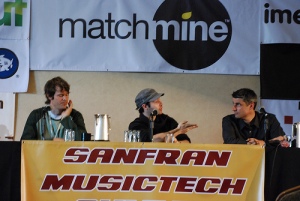
SanFran MusicTech Panel

Photo by Crazywanda. Some rights reserved.

For the virtual comment box, here’s a suggestion: How bout a list of attendees on the website? (Yes, there was a Facebook page you could RSVP on, but not everyone on the planet uses Facebook. Silly planet.) A simple list of attendee names, companies, and titles would be great.

The Web 2.0 Expo brilliantly utilized Crowdvine to set up a social networking site for their event. Here, you could create a profile, view other attendees and ping the people you wanted to meet. Consequently, my first day at the expo was consumed by meetings with some very cool people. Though randomly networking is great, it would be awesome to knows who’s gonna be there beforehand. Brian, whadya think?

My co-worker had the idea of placing RFID tags in everyone’s nametags so you could track people’s whereabouts throughout the day and find those you need to meet, but eventually we all agreed that would be too creepy…”Hey man! Saw that you were in the bathroom, so I thought I’d come introduce myself…” Ha.

At the Artist Activism Workshop Mike Relm, Chris Skarakis (founder and VP of Music at Fuzz), and moderator Erin Potts (Executive Director of Air Traffic Control) discussed how artists can be activists using new technologies. Very inspiring.

Mike Relm, whose live shows feature audio/video mashups “manipulated in real time with a turntable-like device” [Wikipedia] showed us a powerful Katrina video with vivid images, music, and video clips that he made to raise awareness of the disaster.

I so love where this trend is going. There are obviously a ton of ways to get involved in your community or on a more global scale, but musicians are in the perfect position to make a real difference due to their visibility. As much as we (and especially Actual) hate on American Idol, I have to admit I was impressed by how much money they raised during their Idol Gives Back special ($65 million or something, right?). At least they are doing some good with the massive captive audience they have…

But no matter how big or small your reach, there are always ways for musicians to get involved. And organizations like Air Traffic Control, Project Noise and Axis of Justice to help you on your way.

At the Record Labels and New Technologies panel, I walked in anticipating an hour of (big) label bashing, but was quite mistaken. Rather than harping on why big labels are evil and how they are all going to disappear, the consensus seemed to be that record labels are not going anywhere. They are, however, changing. Drastically. Whereas a new artist used to need a label to even get started, now the label has a very different role to play. Turns out that independent labels are actually doing quite well – at least the ones that have found innovative ways to market their bands online. Dave Allen, of the Gang of Four, pointed out that artists and their labels should keep the end user in mind and what most end users want is at least 1 free mp3, not DRM, and the ability to play music on different devices. Dave also has a great music blog, Pampelmoose. Check it out.

In between panels and meeting new people, we also ran into our friends Todd Tate (co-founder of Angry Coffee and now one of our rockstar MixMatchMusic beta testers), Hannes Hesse (the Bubblegum Sequencer guy), and my hero Tom Conrad (CTO of Pandora) among others. One of our guys was chatting with Vince Wilburn, Jr., nephew (and spitting image of) the late Miles Davis (and accomplished drummer and producer)! Seemed like a very cool guy.

All in all, another rockin Summit. Great job, Brian!

Share and Enjoy:
  • Twitter
  • StumbleUpon
  • Digg
  • Facebook
  • del.icio.us
  • MySpace
  • Technorati
  • FriendFeed
  • LinkedIn

Where to Sell Your Music Online

As I’ve been watching the big record labels crumble and the music industry evolve, I’ve become more and more intrigued by the ease with which independent musicians (and big name artists like Radiohead and NIN) are taking matters into their own hands. Record music without the use of a professional studio? Easy. Promote your work on social networking and music discovery sites? No problem. The next question in my mind is: what are the best places to sell your music online? Thus, I’ve compiled a list of sites to do just that. I’m sure it is by no means complete, so feel free to let me know who I’ve missed. In no particular order:

CD Baby – I first heard of CD Baby years ago when my childhood friend and accomplished musician, Mike Stocksdale, let his friends know that his album was available for purchase through them. The “little online record store that sells albums by independent musicians” has been around for a decade and, according to New Music Ideas, has become “one of the biggest digital distributors on the planet.” As you can see on their about page, artists make $6-$12 per album and get paid weekly.

Amie Street – If you weren’t already familiar with Amie Street, you may have seen them mentioned in conjunction with the Eliot Spitzer scandal. Ashley Alexandra Dupré not only posted a few of her songs on her MySpace, but also adroitly thought to post them on Amie Street where “all songs start free and rise in price the more they are purchased.” Predictably, a bunch of people – being the victims of morbid curiosity that we silly humans are – bought the songs, which subsequently rose to the $.98 max. The company gives 70% of song sales back to the artists.

MixPal – Though I only recently discovered (and briefly blogged about) this service, it’s probably one of my favorites. The idea of being able to set your own price, keep most of the proceeds, be paid immediately though PayPal, and even place a MixLink on any other website makes their approach a very attractive one.

BlastMyMusic – Another site that is all about fans supporting the artists directly, BlastMyMusic lets you buy singles OR albums on the artist’s profile on the site or through the “Music Blaster” on the artist’s website(s). Yes, the Music Blaster is also a facebook app – one where “fans can earn 5% for each song they sell and at the same time help gain further exposure for their favorite bands” to boot! Though artists only get 65% of the profit using BlastMyMusic, the widgetized aspect is pretty sweet.

Stage.FM – Formerly known as Audiri and based on the old mp3.com model, Stage.FM allows you to search for music using a tag cloud and tends to emphasize free music. In a great concise review of the site, New Music Ideas notes that while still a bit buggy, the site is great because: “Stage.FM lets artists sell tracks through the site and keep 100% of the sale price. Artists can set the price for each track, from $0.20 to $1.60, or let visitors download it for free. Money from sales is transferred to the artist’s PayPal account every month. And the Stage.FM music player widget lets artists sell their tracks from their own domain and social networks too.” I also like the “find bands near you” feature.

There are far too many services out there to make a comprehensive list, but if your favorite is not listed above, feel free to leave a comment and name your preferred service – with a link to your profile of course!

Also, stay tuned for some revolutionary new ways to sell your music online (piecemeal, for example) through MixMatchMusic, coming soon to a computer near you.

Share and Enjoy:
  • Twitter
  • StumbleUpon
  • Digg
  • Facebook
  • del.icio.us
  • MySpace
  • Technorati
  • FriendFeed
  • LinkedIn

RIAA Screws Musicians!

In a news item that probably shouldn’t surprise us all that much given the recent history of the recording industry and their increasingly desperate attempts to control something that is spiraling quickly out of control, it turns out that the settlements the RIAA has collected from lawsuits with Napster and other file sharing communities have never made it to the artists. Over $400 million dollars, supposedly collected because the artists were losing revenue off of pirated material, has been horded or squandered by the powers that be. While we talk frequently about the diminishing rights of the artists, the new models of distribution and the idea that the record industry is changing rapidly, let us not forget that huge amounts of control still reside with the dinosaurs of the music industry who will do anything to make a buck, even if it’s robbing the exact same artists they claim their legal actions help. Thanks to the consumerist for the update

Share and Enjoy:
  • Twitter
  • StumbleUpon
  • Digg
  • Facebook
  • del.icio.us
  • MySpace
  • Technorati
  • FriendFeed
  • LinkedIn

5 Predictions for Digital Music Trends in 2008

After watching my Mac-obsessed friends win/lose their bets about Steve Jobs’ announcements at the MacWorld Expo this week, I feel obligated to make some predictions of my own. Plus, every self-respecting tech or music blog has to make some predictions for the coming year, right? In no particular order:

1. The beginning of the end of big record labels: With CD sales continuing to plummet and big name artists like Radiohead and Nine Inch Nails cutting out the middle man in favor of a direct relationship with their fans, record labels are beginning to look a bit outdated. Probably not the best place to look for a job right now, anyway.

There are now so many ways that artists and fans can find each other online: band websites, social networking and/or music sharing communities (e.g. MySpace, iMeem, iLike), individual mp3 sales (e.g. iTunes, eMusic, Amie Street), music discovery sites (e.g. Musicovery), internet radio sites (e.g. Pandora, Last.fm) subscription services (e.g. Rhapsody, Napster), webzines (e.g. Pitchfork, Mix) etc. Furthermore, services like Slicethepie and Sellaband are paving the way for a more direct financial and emotional connection between creators and consumers.

Not to mention that artists don’t really need a label to get them started on recording an album anymore. With the plethora of affordable software and equipment available, virtually anyone can record their music at home. At this point, it seems the labels have all but given up on reviving CD sales. So, the question is can they find other ways to be profitable? What’s in store for them in their not-so-big future?

2. Music Search Engines: Several new “playable search” engines allow you to simply type in an artist name and then give you a host of options for a song/artist such as: listen to, buy, share, embed, blog, download ringtone, find tour dates, youtube videos, photos etc. Seeqpod, in my opinion, is the best service so far. Also worth checking out are Songza and SkreemR.

On the flip side, there is the concept of search based on sound recognition, which I think is likely to start catching on. Midomi, a community for music fans, uses MARS (Multimodal Recognition System) Search technology, developed by Melodis. Their goal is to “create a comprehensive database of searchable music based on user contribution”. Can’t remember the name of that song stuck in your head? Sing, whistle or hum it to Midomi, then search!

3. Music Widgets - More and more widgets, typically music players that you can embed into, say, your myspace profile or your blog, are popping up. Facebook, with its innumerable enthusiastic application creators, is of course churning out a ton of music-related apps. I think that 2008 will see not only an increasing number of music widgets but also a much higher level of sophistication in these apps.

4. Copyright Restrictions Lesson – Though still a very sensitive area, it seems there is a general trend toward dropping DRM protections. Even Sony BMG is preparing to join the other top music labels in doing so, in an effort to man up and compete with Apple and its market share.

5. Niche Social Networks for Musicians – Now that social networking has pretty much infiltrated the mainstream and everyone from grandparents to business people are hip to the concept, the industry has begun to specialize. All kinds of niche social networks have been popping up, and I predict that in 2008 this trend will gain significant momentum. With special interest groups ranging from beer lovers (Coastr) to shoestring travelers (CouchSurfing) and everything in between, clearly musicians will be trying the various music related social networks on for size. There are quite a few communities and networks for musicians out there now. Some pretty decent. Some…not so much. Luckily, musicians far and wide will soon have a place to call home.

Share and Enjoy:
  • Twitter
  • StumbleUpon
  • Digg
  • Facebook
  • del.icio.us
  • MySpace
  • Technorati
  • FriendFeed
  • LinkedIn